Sunday, March 8, 2009

13. Kelley Greens Golf Course

Location: Nahant (0:27 NE of Boston, 2:44 E of Pittsfield).
Architect: unknown, 1894 & 1966 / Wayne Stiles, 1929.
Yardage: 1955 (back) / 1841 (middle) / 1731 (front).
Weekend Rates (9 holes): $18. Cart + $12.
Best Deal: $12 (winter!)

Snow covers parts of Kelley Greens' shaded 1st tee.

Kelley Greens clubhouse sits only yards from the Atlantic Ocean, as the course is on an island in the Boston Harbor. Unfortunately, a seawall blocks all view of the water and Boston skyline in the distance, and the course itself does little to take advantage of its unique setting. Originally laid out over tidal swampland at the end of the 19th century, the design morphed into a 3135-yard nine hole course under the guidance of architect Wayne Stiles in 1929. Regrettably, all that remains from his layout is the current wild 2nd green, as the course closed from World War II until 1966, a period during which much of the land was taken over for the town's use. The Kelley Greens Golf Course currently measures under 2000 yards, made up of 6 par threes and 3 short par fours.

Water lurks right at the short 1st.

The best hole at Kelley Greens is found right off the bat at the 1st. Measuring 141 yards and downhill at that, the length poses no issues, but the small convex green next to water certainly does! The severe turtleback nature of the 1st green shrugs indifferent shots off its surface into the pond with ease.

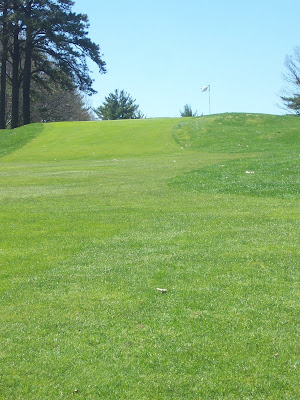
The flagstick's angle gives some hint of the insanely tilted 2nd green.

The 2nd hole measures 181 yards, but despite the additional length, the major concern is once again the green. This green is as severely sloped as any I've ever seen across Massachusetts - if played at even mediocre green speeds I can't imagine a ball staying on it. It's shaped like an upside down egg-shaped bowl, where the only viable pin positions are along the high middle ridge. Hitting the green from the tee is no guarantee of a par, or even a bogey. This is the only remaining green from Wayne Stiles' 1929 design... and what a doozy it is. The 3rd, 4th, and 5th holes measure 187, 160, and 220 yards, respectively; they make you test different clubs in your bag despite the awkward partial blindness created by cattails obscuring parts of the greens. The 6th through 8th holes are the only par fours on the course and offer birdie chances if your drive stays in play. In fact, numbers 7 and 8 are potentially reachable with even less than a driver. The challenge on the 296-yard 7th is gauging how much to cut off the corner of the sharp dogleg left, and the challenge on the 257-yard 8th is keeping the teeball dead straight at the humpbacked green. The course concludes with its second best hole, in my opinion, the 183 yard 9th. The green complex is a bit different but no less challenging than previous ones, defended by a sharp falloff to the right side and a bunker eating into the left of a rolling putting surface. Almost every crazily sloped putting surface on the course stimulates creativity and rewards a skillful short game.

Kelley Greens is by no means a great golf course - the town's decision to use part of the layout for three baseball fields is probably a better use of the marshy land! However, Kelley Greens has one big saving grace in that it is consistently open during the cold winter months due to its proximity to the Atlantic Ocean. Its fairways may be muddy and puddles may abound, but the course is an absolute oasis to golfers craving a game. Get yourself to Kelley Greens on a winter Saturday afternoon - with the round costing only $12, you'll have a few bucks left for a little something to warm up your insides after the brisk walk!

Swampy brown fairway greets the golfer at the 7th hole.

Course Rating: 1 star out of 10

Bang for your $12 bucks: 5 stars out of 10

Thursday, March 5, 2009

12. Crumpin-Fox Club

Location: Bernardston (2:00 NW of Boston, 1:32 NE of Pittsfield).
Architect: Roger Rulewich, 1977/1990
Yardage: 7007 (black) / 6508 (blue) / 5432 (red).
Weekend Rates: $74. Cart + $18.
Best Deal: $44 (weekdays before May 14 or after Oct. 19).
Looking back on Crumpin-Fox's 8th hole: wow.

Crumpin-Fox Club is located far from major Massachusetts cities, costs nearly $100 in the summer, and yet their tee sheet still fills up every weekend. If gas prices stay down, I'll strongly consider a return trip out route 2 to join the crowd at Crumpin-Fox this summer. The club delivers an excellent golf course on top of its laid back, small town atmosphere - it's no wonder it is a destination for golfers across Massachusetts. The eighteen holes ramble across hundreds of acres of rural land, and almost every hole is isolated from its neighbors by thick woods. It takes an orienteering master to figure out in what direction each hole plays and where you are in relation to the clubhouse! Though cut through woods, the trees don't overly encroach on play; instead, a steady diet of elevated greens and a number of creeks and ponds combine to make Crumpin-Fox's layout noticeably difficult.

The first 9 holes at Crumpin-Fox opened in 1977, but the second 9 holes did not open until 1990. Despite the front nine being built 13 years after the back nine, the course enjoys a harmonious feel that can only result from a single steady hand guiding the design. The steady hand in this case is architect Roger Rulewich, who designs courses all over the country, but is headquartered in Bernardston. Golf courses shaped by architects in their own backyard have a storied history: Alister Mackenzie and brilliant Pasatiempo, Donald Ross and renowned Pinehurst, Henry Fownes and brutal Oakmont - the list of pairings is long. Crumpin-Fox is Roger Rulewich's cherished local design, and not surprisingly may be his best work. The watery 592-yard 8th hole is one of the best par fives in Massachusetts, the other three par fives are also outstanding, and the par threes and fours attractively zig-zag through the hilly New England forest.

Fall foliage frames the downhill 193-yard 3rd.

The course opens with two dogleg par fours before arriving at the picturesque par three 3rd hole. The difficulty of the hole is not especially its 193 yards, but its segmented T-shaped putting surface. Attacking a hole back right or back left either requires a high shot of incredible precision, or a bent shot using the greens slope to find the desired quadrant of the green. The front hole location is even more of a bear, as two deep bunkers bracket the extremely narrow target. The 5th hole would be the best hole on many Massachusetts courses, but it isn't even the most memorable par five on Crumpin-Fox's front nine! A white picket fence running up the right side gives the par five great definition as well as wonderful charm. The fairway and flanking fence swing left halfway up the hole's 528 yards, the fairway broken at the dogleg by three bunkers and rough. The hole's green is attractively located on a hilltop, sloped back to front, and guarded by four deep bunkers - the combination of the difficult green complex and the interrupted fairway ensures very few eagle putts. The 448-yard 6th hole plays down and up through the same valley the 5th plays through, and provides balance as it elegantly slides to the right up to a perched green. The 7th hole caps the army-like right, left, right, left dogleg pattern of holes 4 through 7, twisting sharply over bunkers before hopping a small pond to a green placed hard by the water. Just a little warmup before number 8!
One of Massachusetts best par fives is Crumpin-Fox's 8th.

The par five 8th hole places immense pressure on every shot. If a hole as demanding as this were located too early in the round, or in the midst of a string of very difficult holes, it might overwhelm you. But once or twice a round a huge challenge can be a good thing. At 592 yards, the green is not reachable in two shots, especially as the target is located just on the other side of a lake. The goal with the first two shots is to A) avoid the ever-present water on the left and B) advance as far up the fairway as possible to make the approach manageable. With the lake reaching to the very end of the valley, past even the green's distance, every golfer must carry the water at some point. It is not often a great hole forces players into doing a certain thing, but much like the 17th at the TPC of Sawgrass, the 8th at Crumpin-Fox demands an airborne shot to the green or a lost ball is the result. This hole is beautiful, strategic, and tough as nails.

A sliver of green is the elusive target at the downhill 9th.

Any hole would be a letdown after the colossal 8th, but the 9th hole holds its own as best it can by being very different. It measures 188 yards, to a noticeably smaller green located well below the tee's elevation. The design of the green complex, narrowing to the back right and protected in front by an angled creek and bunker, clearly calls for a high fade.

I found the back (original) nine of Crumpin-Fox to be more demanding, but less memorable, than the front nine. A full six of the nine holes have either creeks or ponds in front of their greens, making aerial approaches the only option. The woods seemed to encroach a little more overall and pinched a number of holes in the driving zone quite tightly.

Most of Crumpin-Fox's holes are isolated by woods.

The 10th, 12th, and 13th hole are mid-length par fours, broken by the 161-yard 11th hole. The demands are great despite the reasonable distances, as three of the greens are located just beyond water features. The 14th hole is an excellent reachable par five whose fairway snakes its way around intruding bunkers and trees before terminating short of a pond. The green is large but set hard behind the water, making the heroic second shot an all-or-nothing proposition. The par three 15th hole is a forced carry across the same idyllic pond; the shot measures 175 yards and is angled perpendicularly to the 14th's direction of approach.

The 16th greensite is a beautifully symmetric saddle.

The 16th hole covers 457 yards from the back tees, with a bit of an awkward late dogleg into its inspired hillside greensite. Because the hole turns to the right far (perhaps too far?) up the fairway, only drives down the left side have any sight of the green - drives safely down the right side of the fairway may have no shot at all except a vicious slice around the encroaching trees. The 565-yard 17th hole completes a wonderful collection of par fives. The drive should be faded to hold the left-to-right fairway, and the second shot poses a dilemma with a tree in the middle of the landing area. Confident shots into the narrow gap left of the tree leave a clear view and simple approach down the long axis of the putting surface. Second shots to the right of the tree have a larger landing area, but leave an angled approach over a string of four bunkers.


Left or right? Hazards abound in the last 100 yards of number 17.

Crumpin-Fox closes with an arduous par four, the green located on the far side of yet another small pond. The green itself has a couple great hole locations - a front right tongue that brings the water very much into play, and a back left plateau that requires a high soft shot to carry the pond and stop quickly.

Crumpin-Fox is an excellent golf course, but one I probably wouldn't want to play every day. The profusion of demanding shots, especially on the more clausterphobic back nine, make the course tremendously taxing to play. Individually, many of these tough holes are excellent designs; however, strung back to back to back the forced carries to elevated greens becomes tiring. Crumpin-Fox was clearly built in the era of "championship" golf courses - it features large tiered greens elevated from their surrounds, an abundance of doglegs (I count 9 out of 14 non par threes!), and water fronting fully 9 of the 18 holes. Compare this to nearby Taconic Golf Club, which presents small targets, includes a mere 5 doglegs out of 14 non par three holes, and has water or frontal bunkers in play only on a few holes. I understand the properties are different, of course, but even more striking is how much the ideology of course design has changed from 1925 to the present day. A course being "hard" has become an important measure of its greatness - just look at all the excessive lengthening being done at classic venues like Bethpage Black, site of this year's U.S. Open, or Torrey Pines, site of last year's championship. Is the relentless assault of target golf over ponds and fronting bunkers as fun as it is challenging? I would say no. Crumpin-Fox, while an unquestionably gorgeous and testing layout, is one I wouldn't frequent every weekend.

Course Rating: 7 stars out of 10

Bang for your $74 bucks: 6 stars out of 10

* Dedham Country & Polo Club

Location: Dedham (0:27 SW of Boston, 2:18 E of Pittsfield).
Architect: Seth Raynor, 1925.
Yardage: 6138 (blue) / 5808 (white) / 4918 (gold).
Rates: N/A - private club.

The brilliant and gorgeous 17th at Dedham.

Dedham Country & Polo Club has the type of golf course I would love to play at any age. Measuring only 6138 yards from the back tees, it nonetheless provides a stiff challenge to the low-handicapper while maintaining its playability for youngsters, women, and senior golfers alike. Dedham packs more heroic and dangerous shots into its 6138 yards than most courses a thousand yards lengthier. You never tire of watching your drive on the 1st hole barely make it over the crossing creek, your second on the 4th hole barely scale the massive hill, your drive at the 6th hole barely carry the right bunkers - the list goes on. Trouble lies everywhere, especially when you get overly aggressive trying to shorten already short holes. I've found Dedham can't be overpowered - even on a great driving day, the resulting dozen wedges into greens doesn't guarantee a good score. The greens are small and mostly elevated from their surrounds, and the putting surfaces have tricky undulations that even seasoned members misread frequently. Because the greens are built up from their surrounds (as many Seth Raynor greens are), the adjoining deep slashes of bunkers require high and soft sand shots to escape. Dedham is only getting better with age, as it is currently working through a master plan to restore a number of Raynor features that have been lost over time. Radical architectural changes such as reviving alternate fairway strategies on the 6th and 16th holes, in combination with the restoration of all bunkers to the classic linear Raynor style, make Dedham a fun and historic place to play eighteen holes.

Dedham's 1st tee is located fifty feet above its fairway, and steps behind the 18th green. In fact, the 18th green and 1st tee are connected only by a shallow swale of short grass - talk about a blatant invitation to play an extra couple holes at dusk after the first eighteen! The 1st drive of the day is, unusually, one of the most important of the round - a creek slits the fairway diagonally right about where an average length player's drive would take its first hop. Thus options abound: do you lay up short of the water, making certain a long approach up the steep hill? Or do you try to carry the creek near the right edge of the fairway, risking a penalty stroke on the first swing of the day but possibly earning a short iron into the green? These types of decisions are made all day long at Dedham. The 347-yard 2nd hole is the weakest hole on the course, in my opinion. Long bombers can attempt to carry water and reach the upslope to the elevated green, but the rest of us are (highly) encouraged by a creek/pond combination to lay up before lofting a pinpoint iron to the target.

Google Earth's view of #3: an unconventional, but incredible "Redan".


The 3rd hole at Dedham lies over unremarkable ground: 200 yards of gradual downslope tilting slightly to the left. Actually playing the hole is remarkable, however. A field of fescue and bunkers inhabit the first three-quarters of the hole, concealing the 50 yards of slanted fairway ramp leading to the obscured green. The green, canted to the back left like a true Redan, happily accepts a running draw bouncing in from the right but also a high fade that carries almost onto the putting surface. Though not bunkered front left like a prototypical Raynor Redan, two fierce bunkers await pulled shots or golf balls running too hot through the green. Dedham's 4th hole is 441-yards, but denoted on the scorecard as a par five - probably to achieve a total par of 70 for the course. Though the idea of par shouldn't matter when playing a hole, calling the 4th a par five certainly makes scoring a "4" feel that much better! The drive crosses the same creek in play on the first two holes, and the second shot is an awesome one: to a green located high on a giant hill, where all you can see is the flag against the trees and sky. After the par three 5th, a short iron to a small and wrinkly green, a second short par five awaits across the road at the 6th. Called "Prize Dogleg", the strategy revolves around two fairway bunkers guarding the right side of the fairway 250 yards off the tee. Because the hole turns suddenly to the right just beyond them, either hugging them close or successfully carrying them opens up the option to reach the wild green in two strokes. Bailing out to the left half of the fairway makes the 6th a true three-shotter. The 7th hole is an interesting short par four of 361 yards; after a drive to a humped fairway protected by a new fairway bunker edging in on the left, the green appears in the distance like a small volcano rising a dozen feet above the flatlands around it. Needless to say, a sloppy wedge shot missed to any side of the green complex will bound well down and away from the putting surface! The 8th hole is an interesting par four capped off by a fascinating green complex. Called a "Maiden" green, I have only seen one other one remotely like it - at the municipal Durand Eastman golf course in Rochester, NY. A "Maiden" green contains two high plateaus at its back left and right quadrants, separated by a deep swale. Putting from front to back, or especially side to side at Dedham's 8th green is really challenging - and fun.


An attractive... tee shot at the (partially flooded!) 8th hole.


One of my favorite holes at Dedham is the 334-yard 9th. A swerving fairway ends abruptly 50 yards short of the green, which is located in a dell beyond a rough and bunker covered hillside. You should have glanced at the 9th green while walking up the 8th hole to have an idea where the pin is located over the hill, and thus where your target should be. I've usually played the hole conservatively, with a long iron followed by a short iron - though big hitters could conceivably turn the hole into a drive and pitch by avoiding the hazards fronting the green complex.

No flag in sight for the approach to Dedham's 9th green.

I think the back nine at Dedham is a bit harder than the front nine - it begins with the last par five on the course, a 549-yard roller coaster of a hole. With a large hill intruding into play up the left side for the tee shot, a drainage ditch paralleling the entire right side, a creek meandering across the fairway, and a two-tiered elevated green, I struggle to par this hole every time. The 11th hole is an attractive sharp dogleg - the tee shot is over a rocky hill to a fairway jutting 45 degrees left, leading to a large green located on a knob.

The 11th green's area has been recaptured forward to the crest of the hill.

Dedham's 12th, 13th, 14th, and 15th holes epitomize the variety of targets that make playing the course so enjoyable. The downhill 180-yard 12th's green is convex in nature, repelling shots both long, short, left, and right, making chipping a high priority. The short par four 13th's green is of the punchbowl kind, funneling any ball clearing the fronting bunker toward the middle left of the putting surface. The 202-yard 14th hole is named "Biarritz", though it lacks the normal large swale through its middle section. Its green is built up from the land around it, rises wildly in its back third, and four deep bunkers protect its right and left sides. The 15th hole wraps up with Dedham's craziest green. Modeled after the Road Hole green at St. Andrews, Raynor built up a huge false front deterring weak shots but sloped the rest of the green away from the fairway, sending many approach shots bounding over the putting surface into a well-placed bunker behind. Even with a sand wedge in hand, the shot demands perfect precision.

Dedham sprawls across the land, its holes pointing in all compass directions.

The 16th, 17th, and 18th holes play back across the road on the clubhouse side. The 16th is a 371-yard par four, its fairway rumpling downhill and canted to the left. A grove of trees paralleling the right side inhabits the area where a long-forgotten alternate upper fairway existed; the prospect of returning this option as Dedham's master plan continues will make this solid hole a unique one! My favorite hole at Dedham is the 17th. Named "Reverse Redan", it is a long par three to a green angled from front left to back right. The slope of the green follows this angle, so tee shots can run onto the front edge and safely swerve toward the heavily protected back right quadrant. It is a scenic shot over a pond, full of challenge and strategy. Dedham's eighteen concludes with a very hard 405-yard hole. The unbunkered fairway jogs to the left, leading up an abrupt hill past rock outcroppings to a beautiful greensite. Two excellent shots are needed to find the green; a par four at number 18 is hard-earned indeed.

Dedham embraces its Seth Raynor design.

Dedham is rightfully proud to know their course is a Seth Raynor original design. His familiar set of par threes and creative use of the land on the long holes makes for a distinctive golfing experience. I'd suggest reading the website of the course superintendent, Michael Stachowicz, who clearly embraces both the colorful history and bright future of Dedham's golf course; his site is http://newenglandgreenkeeper.com/. In addition to keeping the course playing wonderfully firm, he has taken out trees across much of the course, elongating the long views of the sprawling landscape. Any golfer should jump at the invitation to play a round at Dedham - the immense scale of many holes masks the diminutive overall length, and the green complexes are first-rate. I love playing old classic designs, and Dedham's rumpling fairways and tiered greens are a wonderful step back in golfing time.

Course Rating: 7 stars

Tuesday, March 3, 2009

11. Amesbury Country Club

Location: Amesbury (0:50 N of Boston / 2:50 NE of Pittsfield).
Architect: Wayne Stiles, 1924.
Yardage: 3156 (back) / 2939 (middle) / 2700 (front).
Weekend Rates (9-holes): $20. Cart + $7.50.
Best Deal: $18 (walking, weekdays).

What a hill! Will these two intrepid walkers make it up to Amesbury's 9th green?

Amesbury Country Club is a relatively short but challenging nine-holer designed by Wayne Stiles. It contains three instantly memorable holes: the 230-yard par three 2nd, for its challenge and (possibly excessive!) pond guarding the green, the short par four 6th, for its alternate greens bracketing a pond, and the par four 9th, for its crazily uphill terrain and 10-foot high flagstick. Amesbury's nine is played over rocky land, and the design works with the undulating landscape as opposed to fighting the severe slopes. Amesbury is the epitome of a small-town club, kept in decent but unremarkable condition, and containing a plethora of holes where par can be earned by the weekend golfer.


The first tee is perched high above the fairway.

Amesbury's first tee is in a perfect location: it sits directly in the shadow of the clubhouse, but high, high above the first fairway getting your blood pumping on the first swing of the day. The hole plays 387 yards, but can play much shorter if you're confident enough to send driver sailing into the narrowing valley far below. A unique boulder jutting out of the beginning of the fairway marks a great line to aim over with a draw. The 2nd hole at Amesbury is as hard a par three as I've tackled: as if 230 yards weren't enough, a small pond guards the front right of the green (where the majority of weak shots end up), and the green itself is canted severely back to front. Take your three (or four!) and run to the third tee!


Amesbury Country Club's nine is routed in a counterclockwise manner.

The 3rd and 4th holes measure 354 and 324 yards, respectively, both of the dogleg-left variety. Like many holes at Amesbury, they feature small greens with mounding around them, protected by bunkers sometimes removed a bit from the putting surface. Catching one of these bunkers removed 15 yards from the green's edge results in the hated long bunker shot as the only chance for recovery.

Looking back, challenging sidehill topography defends the 530-yard 5th.

The 5th hole at Amesbury is special in the way it flows around the corner of its dogleg. The hole bends to the right around a hill, with everything falling toward the left side of the fairway. This reverse-camber dogleg virtually forces a hard left-to-right shot to have any hope of holding the short grass. I thought I hit a good faded drive only to find my ball deep in a hollow through the left side. Next time, got to have even more turn on the ball. The approach is to a green benched into the same hillside falling off to the left; with the ball well above the feet for the approach, it's easy to pull the approach and have it bound well away from the green.

You choose the green at the short par four 6th hole.

The 6th at Amesbury is a fun drivable par four at 299 yards from the elevated middle tee... unless you choose after your drive to loft your second shot over the pond to a new green 50 yards behind the original target! I think the original green is in a superb location to tempt strong golfers to have a go at it, and possibly make a big number in the process. Placed directly behind a pond on the line from the tee, going straight at the hole takes great distance precision. The smart play is to hit left of the green, but a narrow stream trails off that way making even that option a bit dangerous. Any way you play the 6th, decisions must be made and then executed well. After the long par four 7th to a green tucked nicely on a hillock, the 181-yard par three 8th features the best green complex on the course. The neat green is across attractive broken ground, and features a hump within the putting surface along with excellent interior undulations that can quickly sweep golf balls off the green and into adjoining bunkers. Amesbury Country Club finishes on a 395-yard par four that seems to almost angle skyward to the heavens. The drive dies directly into the slope, which feels nearly vertical as you climb it. The second shot is as uncomfortable as I've felt swinging a 7-iron, as just keeping your balance when your front foot is 2 feet above your back foot is challenge enough! The vision of your white ball appearing on the 9th green as you trudge up to the clubhouse's elevation is a sight for sore (or perspiring?) eyes.

Amesbury is a solid golf course, and a very good deal for golfers located north of the Boston area. I would strongly suggest remembering to bring the golf spikes out of the trunk for the round, however... as never has pure traction been the most important factor in finishing the last hole of a round in my experience!

Course Rating: 4 stars out of 10

Bang for your $18 bucks: 7 stars out of 10

10. Wachusett Country Club

Location: West Boylston (1:02 W of Boston / 1:54 E of Pittsfield).
Architect: Donald Ross, 1927.
Yardage: 6567 (blue) / 6170 (white) / 5573 (red).
Weekend Rates: $60. Cart included.
Best deal: $30 (walking, M-Th before 9am or after 3pm).

Wachusett's 5th fairway plunges downward over hilly terrain.

Wachusett Country Club is a hidden gem, unknown to most Massachusetts golfers outside of the Worcester area. If located closer to Boston or Springfield, Wachusett would be overrun with golfers appreciating its classic layout and great conditions. Thus it is wonderful that Wachusett is located where it is - though busy, it retains a sense of calm and serenity found in land removed from city life, and is able to stay in private-course type shape all summer long. Wachusett was laid out by master architect Donald Ross on an old farm in 1927. Most of the course maintains this wide-open feel, but the middle of each nine dives into heavily wooded property, which is home to some of the course's best individual holes. Wachusett's character is only enhanced by the forays into these two different golfing environments, and you leave the eighteenth knowing you've played a very good golf course.

Holes 5-7 bottom left, and 11-14 bottom right are cut out of heavy forest.

Wachusett's front nine begins with a 3-hole loop returning to the clubhouse. The 1st is a typical, and welcome, Donald Ross "handshake" start: a wide fairway greets the downhill tee shot, bordered on the right by a charming stone wall, which points to the large green below. The 2nd is a fascinatingly configured par five measuring 518 yards. The drive is back slightly up the hill the 1st came down, and longer players should play up the right side. Assuming a good drive, the next shot is hit 45 degrees right over a small pond, where the green may be in reach 200 yards beyond and far below. Watching an well-struck wood use the high left ground to bounce down to the large unbunkered green complex is very satisfying. The 3rd hole plays very differently from the back tees (380 yards) and the middle tees (270 yards). It can be a bear from the tips just to reach the green on this very uphill hole - but from the white markers a good drive can carry a large ridge and bound close to the sloped green back near the clubhouse. The next 4 holes play across the road, including the beautiful par five 5th. It covers 507 yards, all through a chute of dense woods. The approach shot is the prettiest on the course, as it is tremendously downhill to a slightly elevated green fronted by a creek and backed by a sparkling pond. The tees on the par three 6th serenely sit adjacent to the pond: the 157-yard shot is an uphill one to a small ledge of a green surrounded by bunkers and forest. Like all classic greens built into a hill, you don't want to be long of the pin! The front nine closes back on the clubhouse side of the street with back-to-back bears of par fours. The 8th measures 436 straight yards, but is a standout hole because of its brilliant green. It's not often you see a green split into sideways tiers instead of front and back ones, but at Wachusett's 8th, the left side of the green is well below the right. Hitting a draw that filters across the green and drops down the slope to a pin on the left is a really fun shot.

The back nine plays through more woods than the front, but on equally rolling land perfectly suited for good golf. After a breather at the par five 10th, the challenge ramps up again at the dogleg left 11th. It plays 430 yards and demands a right-to-left tee shot into a narrow corridor of woods. The approach is not much easier; the target is a narrow and undulating green bunkered left and behind. I think the par four 12th may be even harder than the #2 handicap 11th hole. It measures only 4 yards shorter, and plays through an equally narrow chute of trees. However, the fairway heaves like a roller-coaster all the way from tee to green, ensuring an awkward lie for the long approach. To say the least, Wachusett's snack shack is rightly placed to grab a drink after the beating handed out by numbers 11 and 12.


Wild rolls give character to the distinctive 426-yard 12th hole.

The 198-yard 13th at Wachusett is a classic Donald Ross long par three, playing from high point to high point across a valley - it resembles the 14th hole at George Wright, and continues the string of difficult holes. The remainder of the back nine at Wachusett is far from long, but is comprised of difficult greens and testy wedge shots. The best of the approaches is found at the 316-yard 16th hole, where a flat fairway suddenly rockets upward to a green high above the tee's elevation. Do you lay back for a flat lie but a longer approach shot? Or drive as far up the slope as possible, minimizing the 2nd shot but bringing deep rough and a large fairway bunker into play? I've found both tactics can fail miserably!

The skyline nature of the 16th green hides its wicked back to front slope.

Wachusett closes with a classy pair of holes that slowly transition back to the open land around the clubhouse. The 17th measures 374 yards, ending at a wonderfully canted green, and the 18th at 177 yards is the ever-rare par three finisher. I've always wondered why more courses don't end on a par three, as I love the unique pressure of making one excellent swing to set up a possible finishing birdie putt.

The golf course at Wachusett Country Club has little flashiness, but heaps of old-school character. To any golfer seeking out a challenging golf course but a laid-back atmosphere: make the quick hour's drive from Boston or Springfield to West Boylston, and rediscover the charm that may be missing from your home track.

Course Rating: 6 stars out of 10

Bang for your $30 bucks: 8 stars out of 10

9. Norwood Country Club

Location: Norwood (0:32 SW of Boston / 2:22 east of Pittsfield).
Architect: Sam Mitchell, 1975.
Yardage: 6009 (gold) / 5651 (white) / 4982 (red).
Weekend Rates: $34. Cart + $15.
Best Deal: $10 (1-hour before sunset).

In my opinion, the best thing about Norwood Country Club is the crisp Sam Adams on tap in the clubhouse. The clubhouse is located attached to a strip mall, and the golf course appropriately fits the run-down scene. The first hole is a terrifying start, with a mucky stream paralleling the left side of the fairway, and the high driving range net paralleling the right side of the fairway. I've sliced my first drive off the net back into the fairway a couple times - but also found a hole in the ragged net and lost a ball before! Probably the worst-designed hole on the course is the short par four 2nd; it is also probably the most interesting, which is definitely saying something.


Google Earth illustrates the trees in line from tee to green on the 2nd.
Listed on the card as 261 yards, I've seen as little as a 5-iron reach the green at the 2nd. It is a glorified long par three, with the major problem being tall trees blocking the direct line to the putting surface. Strong players can go up and over the limbs without too much trouble, but weaker players are forced to play two short-irons around the meddlesome grove. Hey, at least the hole forces a decision and induces a thrill if the trees are carried! The best hole at Norwood is the 402-yard 4th: it gently doglegs left, and the approach shot is over a small creek to a medium-sized, rolling green. Nothing extraordinary, but this solid hole stands out among the plethora of back and forth tree-lined "hit it straight" holes throughout the course. The 5th hole is listed as 455-yard par five; however, if a high slice can be hit around the corner, as little as a sand wedge can be hit into the green. I find the best golf courses are relatively easy to remember on a hole-to-hole basis days or even weeks after a round. At Norwood, many of the holes on the back nine run together in my mind. With unremarkable land and few natural features other than the lines of trees separating parallel holes, Norwood's layout is forgettable to me. On the other hand, if you're looking for a cheap late-afternoon round of golf, maybe even preceded by a Sam Adams or two, "The Country Club of Norwood" (as its sign proclaims!) fits the bill nicely.

Too many boring parallel holes on Norwood's back nine at bottom.

Course Rating: 1 star out of 10

Bang for your $34 bucks: 3 stars out of 10

Monday, March 2, 2009

8. Waverly Oaks Golf Club

Location: Plymouth (0:48 south of Boston / 2:54 east of Pittsfield).
Architect: Brian Silva, 1998.
Yardage: 7114 (black), 6182 (green), 4930 (white).
Weekend Rates: $95. Cart included.
Best Deal: $60 (M-Th, after 2pm).

108 (!!) golf holes congregate off of Route 3 in Plymouth.

I have only played Waverly Oaks one time - and I will probably never play it again. But that fact has nothing to do with hating the golf course, and all to do with that the property was sold in 2008 to become a movie studio! Anyone who likes golf and lives between Boston and Cape Cod should make the effort to get to Plymouth and enjoy Waverly Oaks before their doors (cart paths?) shut for good. Waverly Oaks is a modern Brian Silva design, with Silva's trademark deep, rectangular bunkering schemes defending built-up green complexes. The course is a major challenge, measuring over 7000 yards from the back tees, but offers four other tees to fit your skill level. Waverly Oaks is large-scale architecture built on dramatic terrain; I felt on a couple occasions I could slip climbing out of a bunker or ravine and never be heard from again.

The front nine opens and closes weakly with a pair of short par fours - each features a forced layup before a short shot to an elevated green. The 9th hole in particular feels too man-made as the green is awkwardly perched 50 feet above the flat fairway. In between, however, is a good string of holes starting with the rolling 427-yard 2nd: it features a gentle dogleg left for the drive, and an attractive approach over a shallow gully to an large unbunkered green. My favorite hole on the front nine was the par five 5th. The second of back to back par fives, the 531-yard 5th contrasts nicely with the watery 4th hole as it rises to a neat punchbowl green tucked into a hilltop saddle. I think these types of gathering greens work wonderfully on long holes where approaches a bit short or off-line are accelerated toward the putting surface. After consecutive 440-yard par fours, the 8th hole at Waverly Oaks is a stunner of a par three.

Don't miss right at the 207-yard 8th!

The 8th rewards a faded long-iron with room to bounce a shot on from the front-left part of the green; any pin on the right half of the green leaves virtually no room for error. A deep serpentine bunker wraps around the right side of the green, but catching it can be a huge blessing, as the other alternative for a pushed shot is bounding into a scrub-filled ravine. All in all, a challenging and strategic hole.

The back nine, like the front, opens and closes with ho-hum holes. The 10th is a straight 421-yard par four routed through a small valley, and the 18th measures 376 uphill yards with no hazards of great significance or interest. Yet again, the middle of the nine stands up very well, and climaxes at the penultimate hole! The 12th is a striking drivable par four at only 329 yards from the tips and 294 from the middle green tees. Silva pinches the fairway at various distances with three large fairway bunkers, offering challenge for all levels of golfers. If the wind is with and the left fairway bunker can be carried, an eagle putt could await. Thirteen is another well-bunkered hole, with six bunkers (including one smack in the middle of the fairway) scattered along the hole's 537 uphill yards. The 13th concludes with a great undulating green that makes you earn your score until the last putt drops. After the straightforward par three 14th, the 15th hole is a brilliant long par four measuring 474 yards. A bunker nudges in front of the right side of the concave green, but not right against its front edge - there is ample room, as there should be for a long approach, to clear the bunker and bounce onto the punchbowl putting surface.

Route 3 parallels Waverly Oaks' long par four 15th and long par five 16th.

The 16th is a long (636 yards!) par five that demands three solid shots. The drive and second shots are a bit clumsy with the fairway pinched and cascading, but the approach is a beautiful one to a small well-protected green set against a hillside of sand and lone trees. Waverly Oaks' best hole is number 17. Tipping out at 251 yards, and uphill at that, it's a par three in name only. A bit like the famous 16th at Cypress Point in strategy, you can either take on the heroic carry at the green, or bail out to the fairway on the left. Instead of ocean gobbling up a ball hit short, at Waverly Oaks a 25-foot deep bunker awaits the aggressively played but miscalculated shot. It might as well be ocean for most players!

Carrying the chasm at the 17th is a great thrill.

Seth Raynor's architectural influence on Brian Silva is clearly seen at Waverly Oaks. Greens are built up from their natural surrounds, with steep bunker walls leading to sand below. The difference between a great shot and a ball richocheting to death is often a fine line, but fun in a masochistic sort of way. Successfully splashing a sand shot out of a two-story deep bunker (on the third try!) is a shot I won't soon forget... and if Waverly Oaks does go under, I won't forget playing it either.

Course Rating: 6 stars out of 10

Bang for your $60 bucks: 6 stars out of 10